What do you do when you forget your reference samples for a live demo?
Grab a coffee, of course.
At London Lab Live 2026, coffee wasn’t just fuelling the conversations; it became the experiment. We tested freshly brewed coffee with the Lumero particle size analyser to showcase just how flexible the system really is.
And the results? Much more interesting than you might expect from your morning drink.
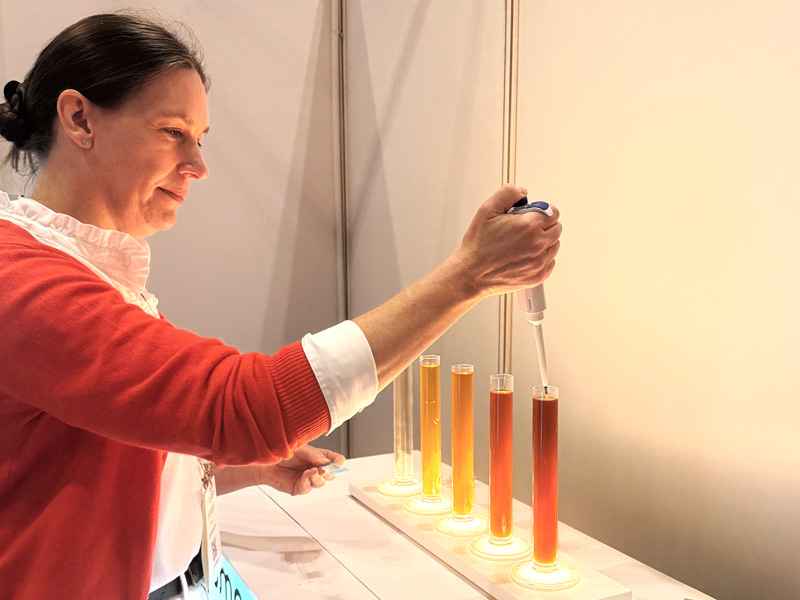
Our live demo highlighted the wide concentration range Lumero can handle, from transparent through to fully opaque samples. Even coloured, light-absorbing particles, typically a challenge for many techniques, were measured without issue. Our eye-catching display of orange/brown solutions was made using Nescafé Original Decaffeinated, diluted to a range of concentrations. Naturally, this became the perfect starting point for the first experiment.
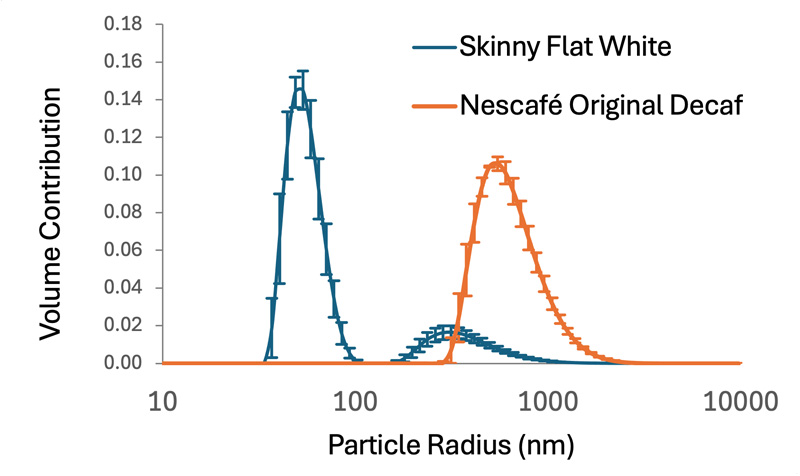
Instant coffee. The most concentrated solution (around 10-20% of the normal concentration for drinking) was loaded straight into the Lumero and was found to have a mean particle radius of 669nm and polydispersity index of 0.18.
Fresh coffee. Now compare that to a skinny flat white (espresso plus skimmed milk) bought from Costa coffee during the event, and things get even more interesting.
This time the equivalent peak has reduced to a mean particle radius of 402nm, , with a significantly larger polydispersity of 0.27. However, a second, much tighter peak appears at a smaller particle size – with a mean particle radius of 82 nm.
This smaller size is consistent with casein micelles, naturally occurring protein structures in milk which are the dominant remaining population after skimming, and are typically in the 25–100 nm radius range, but notoriously difficult to size due to their sensitivity to the environment. Clearly, even without knowledge of the refractive indices, the milk contributes as much to the drink as the coffee – which any coffee drinker can attest to. Suddenly, that simple coffee order becomes a neat demonstration of nanoscale biology in action.